future of robotics

Future of Robotics Engineering in India and Abroad

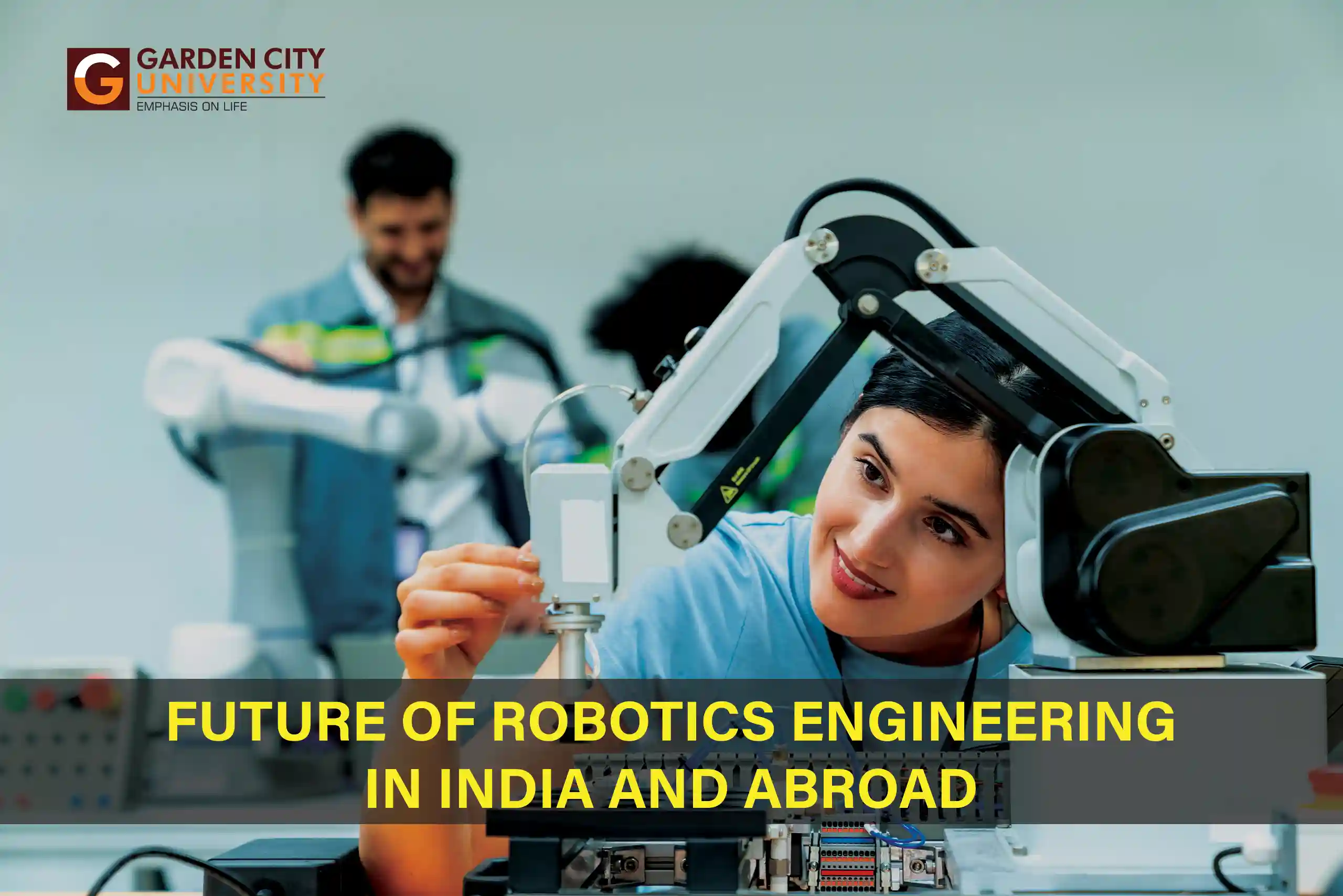
The future of robotics engineering is very promising both in India and abroad, with rapid technological advancements, growing industry adoption, and expanding career opportunities. India is emerging as a significant player in robotics, supported by government initiatives, increasing automation use, and expanding startup ecosystems. Globally, countries like the USA, Germany, Japan, and South Korea lead in robotics innovation, providing students and professionals with high-end research facilities and diverse career paths. The Bachelor of Technology (B.Tech) in Robotic Engineering at Garden City University Bangalore offers a comprehensive, industry-driven curriculum to prepare students for this vibrant field. The Future of Robotics Engineering in India India is witnessing steady growth in the robotics engineering sector fueled by the increased adoption of automation technologies across industries including manufacturing, healthcare, agriculture, and logistics. Currently, automation usage in Indian workplaces is about 14% and is expected to rise significantly in the coming years. Robotics is finding scope in intelligent systems, artificial intelligence (AI) integration, and process optimization. Licensed private organizations, intelligence agencies, and industries are investing heavily in robotics technology to improve efficiency, precision, and safety. The Indian government’s “Make in India” campaign and digitalization initiatives strongly support robotics development. While challenges like the shortage of skilled manpower and regulatory frameworks exist, the growing startup culture and research institutions are helping overcome these. Robotics engineers in India can expect rewarding career prospects with attractive salaries and opportunities in various sectors like space research, entertainment, medicine, and banking. Global Trends in Robotics Engineering Abroad, robotics engineering is advancing rapidly with integration of AI, machine learning, and the Internet of Things (IoT). Robots today are becoming more autonomous, intelligent, and capable of performing complex tasks in fields such as healthcare, transportation, agriculture, and manufacturing. Countries such as the USA, Germany, Japan, South Korea, Canada, and the UK have leading universities and research centers offering cutting-edge robotics education and exposure to state-of-the-art labs and technology. Studying robotics abroad also provides multicultural experiences, networking opportunities, and high employability in the global job market. Collaboration between academia, industries, and government bodies worldwide is driving innovation, enabling new robotic solutions for real-world problems. B.Tech in Robotic Engineering at Garden City University Bangalore Garden City University offers a robust 4-year full-time B.Tech program in Robotic Engineering designed to equip students with essential knowledge and skills. The curriculum focuses on AI, machine learning, deep learning, TensorFlow, and natural language processing along with core robotic engineering subjects. Students learn about robot kinematics, control systems, sensors, actuators, embedded systems, and robotics programming using Python, C++, and MATLAB. The program prepares graduates to design, develop and maintain robots for diverse industrial applications, making them industry-ready. The university provides modern classrooms, advanced laboratories, a well-stocked library, and a strong faculty team to support quality education. Garden City University’s emphasis on research, innovation, and industry collaboration helps students gain practical exposure and opens pathways for rewarding careers in India and abroad. Why Choose Garden City University for Robotics Engineering? Industry-aligned, comprehensive curriculum with advanced courses in AI and machine learning State-of-the-art infrastructure and laboratories for immersive learning Experienced faculty with domain expertise Strong focus on research, innovation, and entrepreneurship Excellent placement prospects in diverse sectors of robotics and automation Located in Bangalore, a major tech hub providing ample internship and job opportunities Supportive campus environment fostering holistic development FAQ What is the scope of robotics engineering in India? Robotics engineering has a vast scope with growing industry adoption in manufacturing, healthcare, agriculture, and defense sectors. Government initiatives and startups are boosting the robotics landscape. What are the key subjects in the B.Tech Robotic Engineering course at Garden City University? Key subjects include AI, machine learning, deep learning, control systems, robot kinematics, sensors and actuators, embedded systems, and robotics programming. What career opportunities are available after a Robotics Engineering degree? Graduates can work as robotics engineers, automation consultants, AI specialists, research scientists, and in roles related to manufacturing, healthcare, space tech, and defense. How is studying robotics engineering abroad different from studying in India? Studying abroad offers access to advanced research facilities, exposure to global innovation, diverse perspectives, and better networking opportunities, though India is quickly advancing its ecosystem. Why should I choose Garden City University for robotics engineering? Garden City University offers an industry-driven curriculum, modern infrastructure, experienced faculty, and located in Bangalore, it connects students to dynamic industry opportunities. Conclusion Choosing to study B.Tech in Robotic Engineering at Garden City University Bangalore is an excellent step for aspiring engineers. It prepares students thoroughly for an exciting and impactful career in India’s growing robotics industry and the international arena. This blend of quality education, industry exposure, and strong placement support makes Garden City University a recommended destination for future robotics engineers.
mba students

Top Skills MBA Students Must Master in the AI Era

Artificial Intelligence (AI) is rapidly revolutionizing business environments. MBA graduates traditionally pursued careers in finance or consulting fields; however, AI is revolutionizing industries by automating tasks, improving data-driven decision making processes, and creating opportunities in tech sectors. Therefore, many companies now seek graduates with an in-depth knowledge of both strategic AI implications and how best to implement it into core business functions. This guide details the essential skills MBA students must acquire in order to thrive in today’s AI era. By harnessing AI’s potential, MBA students can increase productivity, enhance decision making and emerge as leaders of tomorrow’s digitally transformed organizations. The Evolving Role of an MBA in the AI Era AI has drastically transformed MBA studies. Although an MBA remains an invaluable qualification for any industry, graduates are now expected to work alongside AI systems and interpret their outputs to make informed strategic decisions. Thus, many leading MBA programs now provide AI courses so their graduates are equipped with all of the skills necessary for thriving in today’s ever-evolving workplaces. Combining Business Leadership with AI Competence An MBA with an emphasis in artificial intelligence will equip you with both knowledge and practical experience required to become an effective business leader in today’s ever-evolving landscape. Alongside traditional MBA concepts such as organizational management, leadership and financial analysis, you’ll also learn how to leverage AI technologies for improved operations and strengthened decision-making capabilities. As part of an AI-focused MBA program, in addition to learning technical skills you will also develop critical thinking and communication abilities which will be invaluable no matter your career path. These may include: Advance Data Literacy Businesses increasingly depend on data analytics for strategic decision-making, making it essential that MBA graduates possess advanced data literacy. This requires possessing strong fundamentals knowledge of databases and programming languages as well as being capable of using predictive models to predict trends and business outcomes. Communication Skills Now more than ever before, MBA students need strong verbal and written communication skills in order to succeed. This means being able to articulate complex ideas clearly while effectively conveying information across teams or levels within an organization. Ethical Decision-Making An integral component of an MBA education is developing an ethical perspective on technology use within business. This means being able to assess and mitigate any associated risks from AI systems; this can be accomplished through studying ethics, taking a collaborative approach to problem-solving, or participating in leadership development activities. Negotiation skills are also a core element of leadership development programs, and AI cannot fully comprehend or convey cultural nuances or negotiate effectively with stakeholders. It requires empathy and an awareness of cultural differences which can be gained from travel or leadership development programs. Study MBA at Garden City University, Bangalore In order to lead in today’s rapidly changing business environment, future leaders require an MBA course that not only teaches classic management concepts but also involves the future of business. Garden City University (GCU), Bangalore provides a Master of Business Administration (MBA) course that blends academic rigor with industrial applicability. The curriculum combines modern subjects like data analytics, business AI, leadership ethics, and international business strategy. With intense industry connections, project-based learning, and mentorship from experienced faculty, GCU prepares its students with the skills to lead in AI-enabled workplaces in industries. Conclusion The emergence of artificial intelligence is transforming the business environment, and MBA students need to transform with it. By acquiring a mix of technical, analytical, and interpersonal skills, MBA students today can spearhead innovation, impact strategic choices, and negotiate the moral dilemmas of the future business environment. Courses such as the MBA at Garden City University see to it that alumni not only know these changes but are also equipped to lead through them. It is now time to invest in your future — where business intelligence meets AI intelligence.

emerging it technologies

AI, ML and Blockchain: Emerging IT Technologies

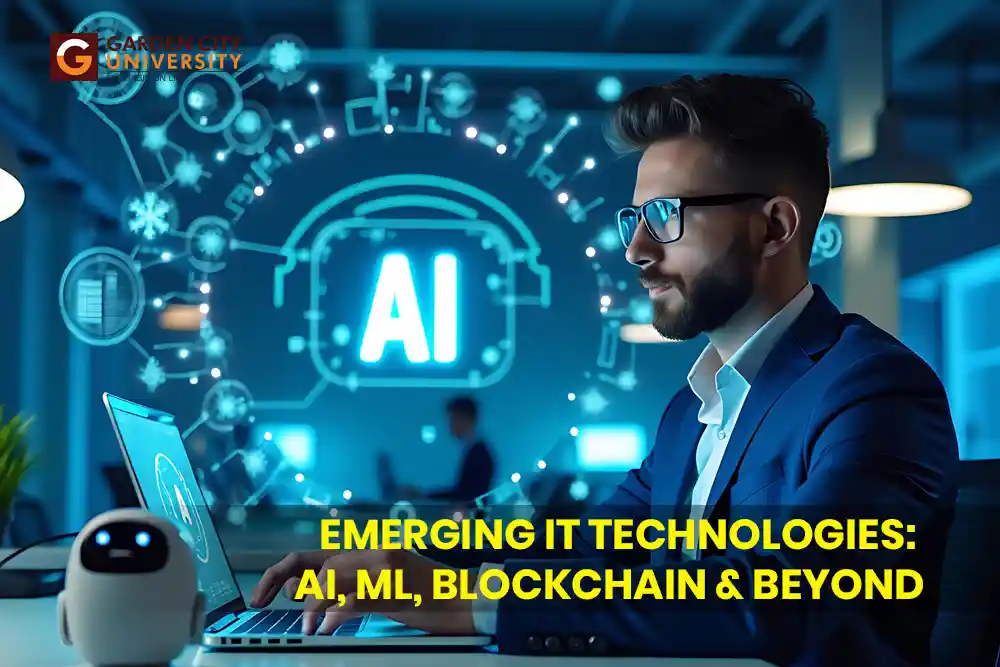
Emerging technologies in today’s digital world are reshaping industry, redefining jobs, and changing the way people live and work. These technologies, which automate complex tasks and create secure digital ecosystems, are at the core of innovation. This blog explores the most significant new IT technologies, such as blockchain, machine learning, artificial intelligence (AI), and others, and how students can get ready for tech jobs by enrolling in courses that cover these topics. Artificial Intelligence (AI): Powering Smart Solutions AI refers to the simulation of human intelligence in machines. It allows systems to learn, reason, and solve problems. Technology has already become part of our daily lives, whether it is smart assistants such as Alexa or AI-powered search engines. Healthcare, Retail, Manufacturing, and Logistics all use AI to improve user experience, optimize operations, and predict outcomes. The demand for AI developers, neural networks and algorithm designers is high across the world. Machine Learning (ML), the Engine of Predictive Analytics Machine Learning is a subset within AI. It involves building systems that get better with time. From Netflix recommendations to Fraud detection in banking, ML helps businesses make smarter decisions without human intervention. Courses in ML cover data analysis, statistical modelling, supervised/unsupervised learning, and deep learning — all crucial for aspiring data scientists and AI engineers. Blockchain Technology: Enabling Trust In A Digital World Blockchain is best known as the decentralized ledger that powers cryptocurrencies such as Bitcoin. But its real-world applications go beyond cryptocurrency. Blockchain is now used in supply chain tracking, digital health records, identity verification, and other systems to ensure security, transparency, decentralization, and more. Blockchain-related certifications and electives are becoming more popular among students interested in cybersecurity, decentralized apps, fintech and blockchain. Cloud Computing: A Scalable and Flexible IT infrastructure Cloud computing allows organizations and users to access computing resources on demand via the Internet. Cloud platforms such as AWS and Microsoft Azure or Google Cloud can support anything from simple analytics to storage. Cloud skills are becoming more important as remote working and Digital Transformation become more popular. The courses in this area focus on Cloud architecture, Deployment models, Security, and DevOps Integration. This offers lucrative career opportunities in system administration and cloud engineering. Internet of Things: Smart Devices for a Smarter World IoT is a technology that connects physical devices with the internet. This allows them to exchange and collect data. IoT makes systems more intelligent, efficient and responsive. Students who are interested in IoT will learn about embedded systems, sensor technology wireless communication and real-time processing. It opens career opportunities in automation, smart city planning, and industrial engineering. Quantum Computing: Computing Beyond Limits Quantum computer, though still in its infancy stage, is poised for revolutionizing industries by solving issues that conventional computers cannot. It uses qubits in place of binary bits. This allows for processing on unimaginable scales. Students who are interested in this new leap are offered introductory courses on quantum algorithms, quantum mechanics and computational theory. Study IT-Focused Programs at Garden City University, Bengaluru Garden City University in Bengaluru has cutting-edge courses that are tailored to the digital age. B.Sc. Data Science Learn core concepts in data analytics, ML, AI, and big data tools Hands-on projects using Python, R, and SQL Prepares students for roles like data analyst, ML engineer, data scientist BCA (Bachelor of Computer Applications) Strong foundation in programming, cloud, cybersecurity, and mobile app development Exposure to AI, ML, and IoT modules Ideal for careers in software development, IT services, and product engineering B.Sc. Information Technology Focus on networking, system administration, web technologies, and IT infrastructure Learn emerging topics like cybersecurity and blockchain fundamentals Designed for roles in IT support, system management, and tech consulting M.Sc. Data Science / M.Sc. IT Advanced specialization for postgraduates in analytics, cloud computing, and AI Includes capstone projects and industry collaborations Prepares students for research, consulting, and leadership roles in IT These programs are designed to bridge academic knowledge with real-world application, helping students stay ahead in today’s tech-driven job market. Conclusion The world is moving fast, and emerging IT technologies are leading the charge. Whether it’s AI transforming healthcare, blockchain disrupting finance, or IoT powering smart homes, the demand for tech-savvy professionals is only going to grow. You can join this exciting revolution by choosing the right academic pathway at Garden City University in Bengaluru. GCU’s future-ready programs and expert faculty are backed by a strong network of industry professionals. This allows students to lead and innovate in the technology world.

Any Queries

Please fill the below form and our representative will get in touch with you at the earliest

Copyright © Garden City University | Developed by Pathway Productions