msc bioinformatics

Best Certifications to Add Value to an MSc Bioinformatics Degree

In the world of life sciences, having an MSc bioinformatics is a solid start, but let’s be honest: the field moves at a terrifying speed. One day you’re mastering Python, and the next, everyone is talking about Single-Cell Sequencing or AI-driven drug discovery. If you want to move from “just another graduate” to a high-value specialist, you need to layer your degree with the right certifications. Think of your Master’s as the engine and these certifications as the turbocharger. Here is a breakdown of what actually adds value in the current market. 1.Cloud Computing Certifications After MSc Bioinformatics Modern bioinformatics has moved out of local servers and into the cloud. Analyzing massive genomic datasets requires serious computational power. Why it matters: Companies are looking for people who can set up pipelines on AWS (Amazon Web Services) or GCP (Google Cloud Platform). The Certification: Look for “AWS Certified Solutions Architect” or “Google Professional Data Engineer.” Being able to manage “Big Data” in the cloud is a massive salary booster. 2. Next-Generation Sequencing (NGS) Data Analysis If you can’t handle NGS data, you’re missing out on a huge chunk of the job market. While you’ll learn the theory in your MSc Bioinformatics, a specialized certification proves you can handle real-world clinical or research data. The Focus: Look for courses that cover RNA-Seq, ChIP-Seq, and Variant Calling. Proficiency in tools like GATK or Bioconductor is non-negotiable. 3. Machine Learning and AI in Genomics We are entering the era of “AlphaFold.” AI is now predicting protein structures and identifying drug targets faster than any human could. The Value Add: A certification in “Machine Learning for Healthcare” or “Deep Learning for Life Sciences” shows that you can build predictive models, not just run existing ones. 4.Advanced Scripting and Version Control Certifications It’s one thing to write a messy script that works on your laptop; it’s another to write production-level code. The Certifications: Advanced Python or R certifications are great, but don’t overlook a certification in Linux System Administration or Git/GitHub workflow. In a professional lab, “reproducible research” is the gold standard. Where the Foundation Meets the Future The reality of Bioinformatics is that you need a learning environment that doesn’t just stick to the syllabus. This is exactly why Garden City University (GCU) has become a hotspot for life science students. The MSc Bioinformatics program at Garden City University is built with an “Industry-First” mindset. They understand that Bioinformatics is a hybrid beast—half Biology, half code. GCU provides the high-end computational labs and the research mentorship required to actually experiment with these certifications in real-time. By the time you graduate from GCU, you aren’t just a Biologist who knows a bit of code; you’re a data scientist who understands the language of life. If you’re looking for a place that encourages this kind of multi-dimensional growth, checking out gardencity.university is a move your future self will thank you for. FAQ 1. Should I wait until I finish my MSc Bioinformatics to start certifications? Definitely not. Start during your third or fourth semester. Many online certifications (like those from Coursera, edX, or NCBI) are self-paced and can be done alongside your lab work. It shows recruiters that you have great time-management skills. 2. Are free certifications worth it? They are great for learning, but for your resume, “Verified” certificates carry more weight. If a company sees that you’ve passed a proctored exam from a recognized provider (like AWS or a top university), it builds much more trust in your skills. 3. Which programming language should I certify in first: R or Python? Python is generally more versatile for machine learning and general scripting, while R is the king of statistical analysis and visualization in biology. If you’re leaning toward data science, go Python. If you’re leaning toward academic research, go R. 4. How much do these certifications cost? It varies wildly. Cloud certs can cost between Rs.8000–Rs.25000, while some specialized Biotech workshops might be more. However, many Universities like Garden City University often provide students with access to discounted or integrated certification programs. 5. Does having 10 certifications look better than having one? No. Quality over quantity. Having one “AWS Solutions Architect” certification is worth more than ten “Introduction to Python” certificates. Focus on the ones that show “Advanced” or “Professional” proficiency. Conclusion Bioinformatics is a field for the curious. Your MSc Bioinformatics gets you into the room, but your certifications tell the world exactly what you’re capable of doing once you’re there. Don’t just collect degrees; collect skills that solve real-world biological problems.

bba Avation

Global Career Scope After Completing BBA Aviation

Let’s be real for a second: when most people hear “aviation career,” they immediately picture a pilot in a crisp uniform or a cabin crew member gliding through an airport. But if you’re enrolled in a BBA Aviation program, you know the truth—the real power moves happen on the ground. The aviation industry is basically a giant, high-stakes puzzle. It’s about managing millions of dollars in assets, navigating the nightmare of global logistics, and ensuring that thousands of people get from Point A to Point B without a hitch. If you’ve got the right degree, the “scope” isn’t just a buzzword; it’s a literal passport to a global career. Here’s where the industry is actually heading and why a BBA Aviation degree is your entry ticket. 1. Airport Operations: The Ground Reality for BBA Aviation Graduates Think of an international airport like a city that never sleeps and has a zero-margin for error. As a BBA Aviation graduate, you aren’t just an employee; you’re the one making sure the “city” doesn’t collapse. The Global Hub Factor: Places like Singapore’s Changi or Dubai International are constantly scouting for management talent to handle terminal operations and ground handling. The Job: You’re coordinating with security, customs, airlines, and retail. It’s fast-paced, stressful, and incredibly rewarding if you’re a natural problem-solver. 2. Revenue Management: The Business Side of Your BBA Aviation Degree Airlines are notorious for having thin profit margins. This is where the business side of your BBA Aviation training becomes your superpower. Pricing Strategy: Why does a seat cost ₹20,000 today and ₹45,000 tomorrow? That’s the work of a Revenue Manager. You’ll be using data analytics to predict demand and set prices that keep the airline in the black. Network Planning: You might find yourself at a headquarters in Doha or Atlanta, deciding which new international routes are worth the investment. 3. Logistics and Air Cargo: The Backbone of the BBA Aviation Career Path While passenger travel gets all the glamour, the real money is often in the belly of the plane. The e-commerce boom has turned air cargo into a juggernaut for anyone with a BBA Aviation background. Global Supply Chains: If you understand how to move a heart transplant or a batch of new iPhones across three continents in 24 hours, you’re golden. Big Players: Companies like FedEx, UPS, and DHL are always looking for aviation business pros to manage their global networks. Why Your Choice of College Changes the Flight Path You can’t learn the nuances of international aviation law or “fare construction” from a generic business textbook. You need an environment that actually smells like jet fuel (metaphorically speaking). This is why Garden City University (GCU) is such a frequent name in this conversation. Their BBA aviation program doesn’t just treat you like another student; they treat you like a future executive. The beauty of studying at Garden City University is the exposure. They get that the aviation world is small and highly networked. Their curriculum is packed with practical modules—like IATA-standard safety protocols and airport strategic planning—that make your resume stand out in a pile of thousands. If you’re serious about a career that spans continents, you need a launchpad like gardencity.university. FAQ 1. Is a BBA enough, or do I need an MBA later? A BBA gets your foot in the door for sure. Many graduates start in operations or junior management and move up. However, if you want to reach the C-suite (think COO or CEO of an airline), an MBA down the line can definitely help. But start with the BBA—the experience you gain in the first three years is priceless. 2. Can I actually work abroad right after graduation? It’s possible, especially in hubs like the Middle East (think Emirates or Etihad), but many students find it easier to gain 1–2 years of experience domestically first. Having a degree from a recognized place like Garden City University makes those international visas a lot easier to justify to employers. 3. What’s the “hidden” career path no one talks about? Aviation Consulting. Firms like Deloitte or specialized aviation consultancies pay big money for people who can tell airlines how to be more efficient. It’s heavy on the “BBA” side of your degree and involves a lot of global travel. 4. How much of the job is “technical” vs. “business”? It’s about 30/70. You don’t need to know how to fly the plane, but you do need to understand the technical constraints—like fuel burn, turnaround times, and maintenance schedules—to make smart business decisions. 5. Is the industry stable? Aviation is resilient. Even when things get tough, the world needs to move goods and people. The shift toward “Green Aviation” and sustainable fuels is also creating a whole new sector of jobs for business graduates who understand sustainability. Conclusion A career in aviation isn’t for people who want a quiet, predictable 9-to-5. It’s for the restless. It’s for the people who want to be part of the reason the world stays connected. If that sounds like you, start building your foundation now.

Computer Science

⁠Role of Internships and Projects in B.Tech Computer Science

Let’s be honest: a B.Tech computer science degree is a great foundation, but it’s rarely enough to land a top-tier role in today’s tech landscape. Every year, thousands of graduates walk across the stage with a degree in hand, but only a fraction are actually “job-ready.” Why? Because there is a massive difference between solving a textbook problem and fixing a broken production server at 3:00 AM. If you want to move beyond just being a “student” and become a true “engineer,” you need to get your hands dirty. This is where internships and personal projects come into play. They aren’t just resume fillers; they are the bridge between knowing the syntax and understanding the system. The Reality Check: Projects are Your Proof of Work In the world of software development, talk is cheap. You can claim to know Python, but a recruiter would much rather see a GitHub repository where you’ve actually built something—maybe a weather app that pulls real-time data or a script that automates a boring task. Solving Real Problems: When you build a project, you run into bugs that aren’t mentioned in your syllabus. You learn how to use Stack Overflow, how to read documentation, and how to debug code. These are the “hidden” skills that make you valuable. The Power of ‘Done’: Finishing a project—from the first line of code to the final deployment—shows grit. It proves you can handle the full lifecycle of a product, not just a small snippet of logic. Internships: A Backstage Pass to the Industry Think of an internship as a “test drive” for your career. It’s likely the first time you’ll see how a professional team operates. You’ll learn that coding is actually a team sport. In a classroom, you’re the only one working on your file. In a professional B.Tech computer science internship, you’re using Git to merge your code with others, attending stand-up meetings, and realizing that writing “clean code” is more important than writing “clever code” that no one else can read. It’s also the best way to network. The person sitting at the next desk could be the one who recommends you for a full-time role six months down the line. Choosing the Right Launchpad The environment where you spend your four years of engineering makes all the difference. You need a place that doesn’t just force-feed you theory but pushes you to build. Garden City University (GCU) has built a reputation for doing exactly that. Their approach to the B.Tech Computer Science curriculum is refreshing because it’s deeply rooted in practical application. At GCU, they don’t just talk about the cloud; they give you the tools to deploy on it. The university’s strong ties with industry leaders mean students get access to internships that actually matter—not just “coffee-running” roles, but positions where you contribute to real codebases. If you’re serious about making a dent in the tech world, checking out gardencity.university might be the best move you make for your career. FAQ 1. I don’t have a high GPA. Can projects save my career? In the tech industry? Absolutely. While a high GPA is a nice bonus, most tech-first companies care more about your “Proof of Work.” If you have a portfolio of 3-4 impressive, working projects, many recruiters will overlook a slightly lower grade. 2. Should I focus on one “big” project or several small ones? Start small to build confidence, but aim for one “Capstsone” project. A deep, complex project where you had to overcome significant hurdles (like optimizing a slow database or securing a login system) makes for a much better interview story than five basic “To-Do List” apps. 3. Are unpaid internships worth it? It depends on the learning curve. If the internship offers you a chance to work with a modern tech stack and provides mentorship from senior devs, the knowledge gained can be worth far more than a small stipend. However, always prioritize roles where you are actually learning and not just doing data entry. 4. How do I find project ideas that aren’t “cliché”? Look at your own life. Is there something you do every day that is annoying? Build a tool to fix it. Whether it’s a bot that tracks price drops on your favorite store or an app to organize your college notes, the best projects come from genuine problems. 5. What is the biggest mistake students make in their final year? Waiting until the final semester to start their project or look for an internship. The tech world is fast. By the time you graduate, you should already have at least one internship under your belt and a GitHub profile that looks “active.” Conclusion The jump from an academic environment to a professional one is steep, but you don’t have to climb it alone. By focusing on building real-world projects and securing internships early, you set yourself apart from the crowd. Education should be an experience, not just a series of examinations. Explore the B.Tech programs at Garden City University and see how an industry-aligned curriculum can change your trajectory. Visit gardencity.university to see how they turn students into creators.

commerce student

⁠Soft Skills Every Bachelor of Commerce Student Must Develop

In the ever-evolving Indian corporate landscape, the Bachelor of Commerce (B.Com) degree remains one of the most versatile qualifications. However, as we head further into 2026, the definition of a “successful commerce student” has shifted. It is no longer just about tallying balance sheets or mastering GST calculations. The Indian job market is currently witnessing a massive demand for “Human-Centric” skills. While your technical knowledge (Hard Skills) gets you the interview, it is your Soft Skills that get you the job and the subsequent promotions. If you are a commerce student looking to stand out in a sea of graduates, here are the non-negotiable soft skills you must cultivate. 1. Persuasive Business Communication In India, the ability to communicate isn’t just about speaking English fluently; it’s about articulation and context. Whether you are explaining a financial discrepancy to a client in Mumbai or presenting a budget proposal to a board in Bengaluru, you need to be clear and persuasive. Written Communication: Mastering professional emails and report writing is crucial. A commerce student must know how to summarize a 50-page audit into a 1-page executive summary. Active Listening: In consultancy and banking, listening to a client’s “pain points” is more important than talking about your services. 2. Emotional Intelligence (EQ) over IQ The modern Indian workplace is a melting pot of cultures and temperaments. Technical brilliance often fails if you cannot manage office dynamics. Conflict Resolution: Can you handle a heated argument during a month-end closing without losing your cool? Empathy: Understanding why a teammate is lagging can help you lead better than just demanding results. 3. Critical Thinking and Problem-Solving Rote learning is a thing of the past. Today’s employers look for commerce graduates who can look at a set of numbers and ask, “Why is this happening?” rather than just “What is the total?” As a commerce student, you should be able to: Identify patterns in market trends. Suggest cost-cutting measures that don’t compromise quality. Navigate the “grey areas” of business ethics and compliance. 4. Adaptability and Continuous Learning With the rise of Generative AI in accounting and Fintech, the tools you use today might be obsolete tomorrow. The most successful professionals are those who are “lifelong learners.” Being adaptable means being ready to unlearn old manual bookkeeping methods and embrace automated, AI-driven analytics. 5. Time Management and Prioritization In the world of finance, deadlines are sacrosanct. Missing a tax filing date or a month-end report has real financial consequences. A pro commerce student knows how to use tools like Trello or simple Eisenhower Matrices to distinguish between what is “Urgent” and what is “Important.” Why Choosing the Right Institution Matters You can read about soft skills in books, but you can only develop them in an environment that mimics the real world. This is where Garden City University (GCU) stands apart. Located in the heart of India’s Silicon Valley, Bengaluru, Garden City University doesn’t just teach the B.Com syllabus; they groom future leaders. Their Bachelor of Commerce (Hons) programs, especially the ones integrated with ACCA (UK), are designed with a heavy emphasis on “Professional Skills” and “Ethics.” At GCU, students participate in immersive case studies, industry interactions, and soft-skills workshops that bridge the gap between “knowing” and “doing.” If you want a degree that carries weight in the global market, exploring the commerce programs at gardencity.university is a step in the right direction. FAQ 1. Are soft skills more important than technical skills for a commerce student? Not necessarily “more” important, but they are the “multiplier.” Your technical skills are your foundation, but soft skills like communication and leadership determine how high you can build your career. In 2026, most technical tasks are being automated, making human-centric soft skills the primary differentiator. 2. How can I improve my public speaking skills during my B.Com? The best way is through practice. Join college clubs, participate in inter-college fests, or volunteer for seminar presentations. Institutions like Garden City University provide dedicated platforms and clubs to help students overcome stage fright and polish their oratory skills. 3. Does having soft skills help in getting a higher salary? Absolutely. Data from Indian recruitment portals suggests that candidates with strong leadership and negotiation skills often secure 15–20% higher starting packages compared to those with only technical certifications. 4. Can soft skills be learned, or are they innate? Soft skills are like muscles; they can be developed with consistent practice and the right environment. While some people are naturally more extroverted, anyone can learn the “mechanics” of good communication, time management, and professional etiquette. 5. What is the most in-demand soft skill in the finance sector today? Currently, Critical Thinking and Adaptability are at the top. With the rapid shift toward Fintech and AI-driven auditing, firms need people who can interpret AI-generated data and adapt to new regulatory frameworks quickly. Conclusion Ultimately, a B.Com degree provides the roadmap, but your soft skills are the engine that will actually drive your career forward. In an era where technical tasks are increasingly automated, your ability to lead, negotiate, and think critically remains your greatest competitive advantage. By choosing a forward-thinking institution like Garden City University, you ensure that your education goes beyond the textbook, transforming you into a polished professional ready to conquer the global corporate stage.

Challenges Faced by PhD Students and How to Overcome Them

Pursuing a Ph.D. is an exciting yet demanding journey that tests a student’s resilience, dedication, and ability to manage multiple challenges. While doctoral studies offer the opportunity to become an expert and contribute original knowledge to a field, Ph.D. candidates often face several mental, academic, and practical hurdles that can impede their progress and well-being. Understanding these challenges and adopting effective strategies to overcome them is crucial for a successful and fulfilling Ph.D. experience. Common Challenges Faced by Ph.D. Students 1. Isolation and Loneliness Ph.D. research can be a solitary endeavor, leaving students feeling disconnected from peers and support networks. The lack of regular social interactions can contribute to feelings of loneliness and impact mental health. 2. Time Management Difficulties Balancing research, coursework, teaching responsibilities, and personal life demands strong time management skills. Many Ph.D. students struggle to meet deadlines while maintaining quality in their work. 3. Financial Pressures Limited funding and the competitive nature of securing scholarships or grants cause financial stress for many students, which can distract from their research focus. 4. Supervisor Relationship Issues Disagreements or misalignment with supervisors can create conflict and hinder academic progress, causing frustration and delays. 5. Academic and Publication Pressure Ph.D. candidates are under constant pressure to produce original and publishable research, which can lead to stress, self-doubt, and fear of failure. 6. Mental Health Concerns High levels of stress, anxiety, and symptoms of depression are prevalent among Ph.D. students, exacerbated by imposter syndrome and workload intensity. Strategies to Overcome Ph.D. Challenges Build a Support Network Engage actively with peers, mentors, and supervisors. Attend academic seminars, workshops, and social events to create a community that understands the Ph.D. journey. Develop a Realistic Schedule Use effective time management techniques such as goal-setting, the Pomodoro technique, and prioritizing tasks to maintain balance and productivity. Seek Financial Aid and Opportunities Explore teaching assistantships, research grants, and part-time roles related to your field to ease financial burdens without compromising research. Maintain Open Communication Regularly discuss your expectations and progress with your supervisor. Address conflicts early to find constructive solutions. Focus on Mental Wellness Prioritize self-care, take breaks, and seek professional help if needed. Practice mindfulness, exercise, and hobbies outside of academia to reduce burnout. Embrace Failure as Learning View setbacks as growth opportunities. Consult peers and advisors for feedback and maintain resilience throughout. Why Choose Garden City University for Your Ph.D.? Garden City University (GCU), Bangalore, offers an enriching Ph.D. program designed to cultivate global research skills and knowledge aimed at solving real-world problems through impactful and transdisciplinary research. GCU encourages scholars to engage in research beneficial to society, policymakers, and industry practitioners, with opportunities extending beyond publications to patents and market applications. Ph.D. scholars at GCU benefit from a vibrant academic environment with access to expert supervisors across diverse disciplines including management, life sciences, computational sciences, media studies, psychology, and more. The university’s emphasis on collaboration, innovation, and real-time problem-solving equips students with practical competencies to excel in their careers. By joining GCU, Ph.D. students gain access to academic mentorship, cutting-edge infrastructure, a strong research community, and opportunities for interdisciplinary projects, all within the dynamic and entrepreneurial city of Bangalore. FAQ How can Ph.D. students manage stress effectively? Prioritize self-care, set realistic goals, take breaks, and seek support from peers or professionals to manage stress during the Ph.D. journey. What should I do if I have conflicts with my supervisor? Communicate openly about the issues, seek mediation if necessary, and try to establish clear expectations and goals for your research work. How important is time management in completing a Ph.D.? Extremely important. Efficient time management helps balance research, coursework, and personal life, preventing burnout and ensuring steady progress. Can financial challenges affect a Ph.D. student’s performance? Yes, financial stress can distract from research focus. Exploring scholarships, grants, and assistantships can alleviate financial burdens and support academic success. Why is Garden City University a good choice for pursuing a Ph.D.? GCU offers a supportive research environment with expert faculty, interdisciplinary opportunities, access to resources, and emphasis on impactful, real-world solutions. For those embarking on or continuing their Ph.D. journey, Garden City University, Bangalore, stands out as an excellent institution that fosters academic excellence, innovation, and practical research skills, providing a strong foundation for future success.

psychology students

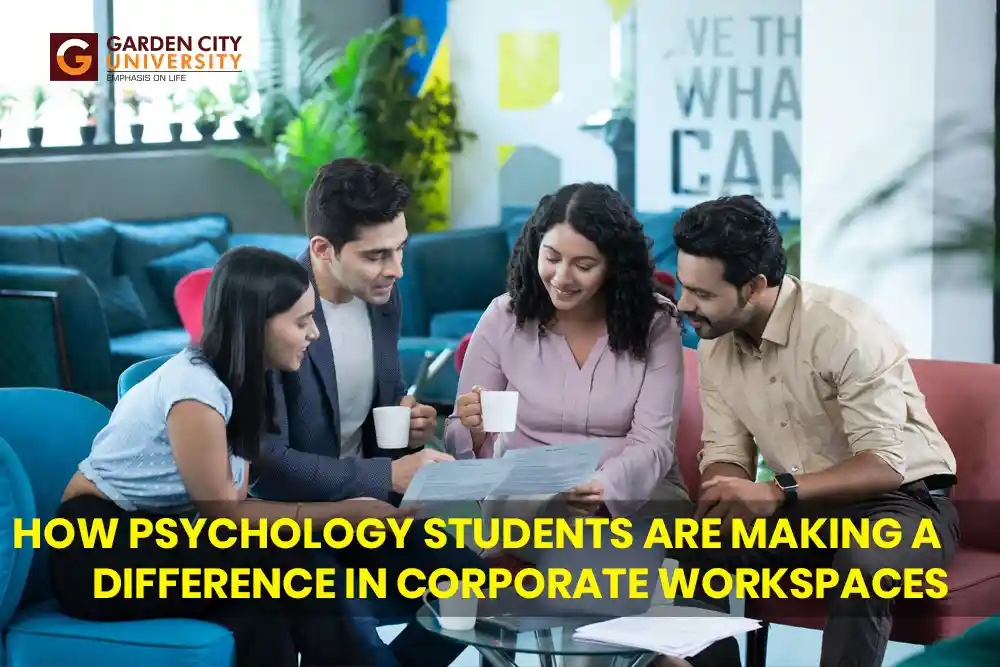
How Psychology Students Are Making a Difference in Corporate Workspaces

Psychology is no longer limited to clinics and counseling suites—today it’s having a forceful influence on the corporate world. With more companies concentrating on workers’ well-being, motivation, and office politics, psychology students are filling positions where their knowledge of human behavior is an enormous strength. Here’s how psychology students are making valuable contributions to the corporate space and how their skillset has never been more applicable. The Strengths of a Psychology Student As a psychology student, you have become adept at conducting academic research. You understand APA style–introduction, method, results, discussion–and are adept at designing psychological experiments with ease. Furthermore, your ability to relate to others stems from understanding that different people act in different ways with varied motivations for their behaviors; you’re a great listener with the knack for providing thoughtful advice. Empathy and Awareness: The Psychology Student Advantage Your friends depend on you for insight, and you’re often the first one to notice problems in their work or social life. Your empathy led you to pursue this field of study and is the fuel behind your desire to help. Academic Rigor and Passion for Psychology Have you been spending more time in the library than your dorm room, and are adept at writing APA papers and lab reports? Maybe you are also up-to-date with research findings, reading the work of famous psychologists such as Sigmund Freud, Albert Bandura, Ivan Pavlov and Wilhelm Wundt? Applying Psychology in the Corporate World At this point in your college career, you are prepared to embark on new challenges and put your psychology degree to good use. Many are considering graduate programs while others might prefer working in corporate environments. Psychologists can make a considerable contribution to any workplace environment by helping create an atmosphere that inspires employees and offers rewards; additionally they can decrease stress levels while increasing job satisfaction levels. Psychologists can be invaluable assets during the hiring process, by helping identify candidates who will be both happy and productive at work. They can train human resources managers in how to conduct behavioral interviews as well as creating tests for evaluating job applicants. Gaining Experience While You Study Psychology students need practical experience while they complete their degree, so obtaining part-time jobs, summer placements or internships are beneficial in this regard. Many universities even provide a year out in industry as part of the degree, giving students hands-on experience and applying academic knowledge directly in real world settings. When given these experiences psychology graduates become highly effective employees across roles like human resources management or marketing. Study Psychology at Garden City University, Bangalore If you’re passionate about using psychology to make a real-world impact, Garden City University (GCU), Bangalore offers the perfect environment to shape your career. GCU provides multiple psychology-focused programs including Bachelor of Science in Psychology, B.A. in English and Psychology, M.Sc. Psychology, and even a Doctor of Philosophy (Ph.D.) in Psychology. These programs combine academic excellence with industry exposure, practical training, and opportunities for research. With experienced faculty and a strong focus on employability, students gain not only theoretical knowledge but also the skills and confidence to work in corporate, clinical, or research settings. Conclusion Psychology students are uniquely positioned to bring empathy, insight, and analytical thinking into the workplace. From improving team dynamics to influencing hiring strategies, their impact is being increasingly recognized across industries. By choosing the right academic path—such as the programs offered at Garden City University—you can turn your passion for understanding people into a rewarding and meaningful career. The future of work is human-centered, and psychology students are at the heart of it.

mba students

Top Skills MBA Students Must Master in the AI Era

Artificial Intelligence (AI) is rapidly revolutionizing business environments. MBA graduates traditionally pursued careers in finance or consulting fields; however, AI is revolutionizing industries by automating tasks, improving data-driven decision making processes, and creating opportunities in tech sectors. Therefore, many companies now seek graduates with an in-depth knowledge of both strategic AI implications and how best to implement it into core business functions. This guide details the essential skills MBA students must acquire in order to thrive in today’s AI era. By harnessing AI’s potential, MBA students can increase productivity, enhance decision making and emerge as leaders of tomorrow’s digitally transformed organizations. The Evolving Role of an MBA in the AI Era AI has drastically transformed MBA studies. Although an MBA remains an invaluable qualification for any industry, graduates are now expected to work alongside AI systems and interpret their outputs to make informed strategic decisions. Thus, many leading MBA programs now provide AI courses so their graduates are equipped with all of the skills necessary for thriving in today’s ever-evolving workplaces. Combining Business Leadership with AI Competence An MBA with an emphasis in artificial intelligence will equip you with both knowledge and practical experience required to become an effective business leader in today’s ever-evolving landscape. Alongside traditional MBA concepts such as organizational management, leadership and financial analysis, you’ll also learn how to leverage AI technologies for improved operations and strengthened decision-making capabilities. As part of an AI-focused MBA program, in addition to learning technical skills you will also develop critical thinking and communication abilities which will be invaluable no matter your career path. These may include: Advance Data Literacy Businesses increasingly depend on data analytics for strategic decision-making, making it essential that MBA graduates possess advanced data literacy. This requires possessing strong fundamentals knowledge of databases and programming languages as well as being capable of using predictive models to predict trends and business outcomes. Communication Skills Now more than ever before, MBA students need strong verbal and written communication skills in order to succeed. This means being able to articulate complex ideas clearly while effectively conveying information across teams or levels within an organization. Ethical Decision-Making An integral component of an MBA education is developing an ethical perspective on technology use within business. This means being able to assess and mitigate any associated risks from AI systems; this can be accomplished through studying ethics, taking a collaborative approach to problem-solving, or participating in leadership development activities. Negotiation skills are also a core element of leadership development programs, and AI cannot fully comprehend or convey cultural nuances or negotiate effectively with stakeholders. It requires empathy and an awareness of cultural differences which can be gained from travel or leadership development programs. Study MBA at Garden City University, Bangalore In order to lead in today’s rapidly changing business environment, future leaders require an MBA course that not only teaches classic management concepts but also involves the future of business. Garden City University (GCU), Bangalore provides a Master of Business Administration (MBA) course that blends academic rigor with industrial applicability. The curriculum combines modern subjects like data analytics, business AI, leadership ethics, and international business strategy. With intense industry connections, project-based learning, and mentorship from experienced faculty, GCU prepares its students with the skills to lead in AI-enabled workplaces in industries. Conclusion The emergence of artificial intelligence is transforming the business environment, and MBA students need to transform with it. By acquiring a mix of technical, analytical, and interpersonal skills, MBA students today can spearhead innovation, impact strategic choices, and negotiate the moral dilemmas of the future business environment. Courses such as the MBA at Garden City University see to it that alumni not only know these changes but are also equipped to lead through them. It is now time to invest in your future — where business intelligence meets AI intelligence.

why learning python

Why Learning Python Is Essential For Data Science Students?

Python is an immensely flexible programming language that can be applied across a range of data science applications. Thanks to its user-friendliness and extensive libraries, it makes an invaluable tool for analyzing data, building models, and creating visual representations of findings. With many tools and resources – such as open source software libraries – available, learning Python quickly will get you into data science fast! A Strong Foundation for Aspiring Data Scientists Many aspiring data scientists mistakenly believe they must know all of the latest programming languages to succeed as data scientists, when in reality Python provides a great foundation. One of the most stable programming languages available, Python continues to adapt as data science evolves. Future-Proofing Your Skills with Python Python will remain relevant in the near future and is an excellent way for those interested in entering data science to do so. Furthermore, learning Python will enable you to grasp other data science applications like machine learning, natural language processing and image processing more easily. The Interdisciplinary Nature of Data Science Data science is an interdisciplinary field requiring expertise in programming, statistics and data visualization. Programming allows data scientists to manipulate and analyze datasets while statistics provides the framework for evaluating and quantifying them. Data visualization offers another dimension by making insights easily understood to communicate insights to decision-makers and encourage better decision making processes. Getting Started with Python: Learn and Practice Learning these skills may seem intimidating at first, but there are numerous resources available to you to get you started. Beginner-friendly courses and online tutorials provide you with a basic introduction to Python such as variables, data structures, and coding principles. Once you’ve acquired those fundamentals it’s essential to practice by engaging in hands-on coding challenges which will develop problem-solving abilities while adding projects to your portfolio. Key Python Libraries for Data Science Python offers numerous key libraries for data science, including pandas, Scikit-learn, TensorFlow and Matplotlib – open-source high performance libraries designed to manipulate and analyze large datasets quickly and efficiently while performing complex statistical calculations or training neural networks. By taking advantage of Python libraries you will complete data analysis tasks faster and more efficiently than other languages. Community Support and Learning Resources One advantage to why learning Python is highly recommended is its expansive community, making it easier to find answers when you run into trouble and taking advantage of a wide array of online resources to speed up and facilitate your progress. The Importance of Communication in Data Science Data scientists must be able to effectively communicate their insights to their audience. This requires strong written and verbal communication skills as well as the ability to explain complex topics so non-technical audiences can easily comprehend. Additionally, data scientists must work effectively within diverse teams. Build Your Data Science Career at Garden City University, Bangalore If you’re serious about pursuing a career in data science, AI, cyber security, or cloud computing, the first step is enrolling in the right academic program. At Garden City University, Bangalore, we offer a wide range of future-ready courses that incorporate Python as a core skill: B.Sc. in Data Science and Cyber Security M.Sc. in Data Science and Analytics M.Sc. IT (AI & ML) / Data Science & Cloud Computing Each program is designed with a strong industry focus, practical hands-on training, and access to real-world tools and technologies. You’ll learn from expert faculty and gain skills in Python, machine learning, cloud platforms, and cyber security — preparing you for successful roles in the tech industry. Ready to start your journey? Choose a program that sets you up for success. Choose Garden City University, Bangalore — where data science careers begin with Python.

Routine in Your College Life

Importance of having a Routine in Your College Life

The Transition The transition from a school student to a college fresher is immaculate. You instantly start behaving differently, you dress a little quirkier, you have a whole new set of friends, and in fact, a whole new life, right? All the things your parents and others said you could do later, once you get into college can be ticked off that bucket list now. So much to do in such little time. While the college life in itself is a whole new experience and every day an adventure, no one really tells us how to make the best of it. Looking back at my “fresher” days, I remember how excited I was about literally everything in life. From college fests, events, assignments, internships, Canteen Food, everything. I wanted to experience it all to the fullest. Unfortunately, even before I knew it, I was engulfed by the huge heap of assignments and deadlines while trying to catch up on my favorite TV show, keeping up with my friends and trying to stay sane. Relatable? Keep reading to know how you can make the best of this experience. The “Academic-Life” Balance While they say “You will enjoy your college life” they also conveniently leave the “you’ll-drown-in hectic-timelines-the-numerous-assignments-presentations-exams-etc” part of it all. From hanging out with your friends almost every day, you go to rarely meeting them after college as you have to complete those pending assignments. While all of this is happening, one fine day you suddenly realize how much you actually are missing out on. In between all of this you neglect your health, sleep pattern is messed up, and you hardly ever have some “me” time. Which to be honest, is important. Among the plethora of things I wish I’d known as a fresher or even as a college student, if I had to pick one, I’d pick the importance of having a routine. While this sounds mundane and something you can “deal with” when it happens and/or something you think is not that important, trust me, it is imperative. It took me almost a year after leaving college to realize and understand the importance of having a routine and how that could have reduced the anxiety I had throughout those years. Sure, you might argue saying the term routine in itself sounds “robotic,” however, on the contrary, it helps you step back and take a fresh breath of air more often, which is a win, to begin with. A routine also helps you manage your time and chores accordingly, thereby making it a good academic-life balance. It basically helps you have “a life.” Why it is important Why is following a routine important you may ask. Routine basically helps you manage time and tasks better. When you manage your time, you get more chores done, you focus on the activity better, your anxiety is manageable, and you get to focus on yourself for a change thereby making you feel healthier and happier. Healthy You Happy You Following a routine has its own health benefits. The better you plan and stick to your routine, you focus on eating better, you catch up on your sleep, you set your priorities and tend to procrastinate lesser. Proper rest has a direct impact on the quality of work you do. The clearer your mind is and the better you are rested will affect how well you think, how much you get done and how you function through the day. How to find your routine Not everyone can follow the same routine, having said that, you can, however, take inspiration from sample routine patterns online and customize it according to your need and lifestyle. As and when you complete tasks the sense of accomplishment will further boost your confidence and drive you to do better. The better you plan your day, the better you manage things and thereby accomplish more than what you would if you did not follow a routine. This also helps in avoiding any unforeseen circumstance that could impact your productivity. Keeping in mind the current situation where nothing is certain, a routine undoubtedly helps keep you sane. Looking at how the year 2020 commenced and how all our plans went to a toss, most of us realized we did not accomplish much while we had the time on our hands. I understand a number of people had a tough time in 2020, however, I look at it differently. We have the time and the resources to get things done, learn new skills, try something you always wanted to, pick up a new hobby etc. All of this is possible only if there is a routine in place, or else everything goes haywire. Just remember to follow a simple routine, you do not want to overburden yourself and put too much on your plate. Customize your routine to compliment your lifestyle A decent pattern that helps you cover all the necessary areas of work/study is good enough. Allow me to share a sample of what I am talking about. Mandatory tasks- Narrow down your mandatory tasks – your sleeping hours, meals, breaks, chores, academics, work, hobbies, etc. Sub-categories – Set sub-categories for the said tasks and allocate time for the same. Set small goals – Example, will finish chapter 2-5 today and 6-8 tomorrow. Consistency is your best friend – Set a specific time and duration for each task and follow the same time pattern Be prepared – if you have everything prepared and ready to start, you will not procrastinate. Track your progress – how much was expected to complete, what is done, what is pending, etc. Reward yourself – will watch one episode of friends once chapter 2-5 is complete. Conclusion I know this sounds overwhelming, however, once you set a routine and follow the pattern in no time you will notice the positive change in the way you work and get things done. You will have to create a couple of routine patterns before you are

3d printing

How 3D printing can transform our lives in the next 10 years

With the necessary evolution of human life, the advancement of technology has evolved into the only way to move forward and continually survive. One such pattern of technological evolution is the much spoken about 3D printing. If you really zero in the origination of 3D printing, you will realise that the concept of 3D printing comes from the singular notion of need. There is an increasing need to create products, models, prototypes; since it has become more important currently. Likewise, it was only a matter of time that these numerous benefits to using 3D printing, has led to the inherent belief that 3D printing will become a way of life and education too. Here are some ways through which 3D printing can transform our lives in the next 10 years: 1. The Burgeoning field of Biotechnology Like all kinds of technology, the advent of 3D printing is a massive paradigmatic shift and a revolutionary change. As you can see, in the field of biotechnology and biochemistry, the value of 3D printing is increasing day by day. In fact, did you know that scientists predict that it will be the only way forward for this field? Read on to understand this further! As we are well aware, Biotechnology is an integral group of studies that supports the data from biology and harnesses it to drive solutions. In this field, the importance of technology is at an all-time high. Therefore, the usage of 3D printing here can be understood in the sense that it allows the creation of tissues and cells by using a 3D printing method. By depositing each layer, biotechnology can create medical parts with the ability to create tissues of similar properties as the natural human body. These structures have applications in multiple fields, such as tissue engineering, medical engineering and so on. Due to the importance placed on this 3D printing in the biotechnology field, the way to master is also a meticulous process. Very few universities offer a thoroughly planned curriculum with enough exposure to practice. Garden City University ‘s B.Sc. in Biotechnology, Biochemistry & Genetics is a unique course which is packed with an advanced framework that helps students get a first-hand understanding of the industry. Through this course, even though the students can’t understand how 3D printing works and the scenarios that revolve around 3D printing, but it gives a thorough insight into the associated disciplines such as molecular biology, biochemistry, microbiology, genetics and so on. What we need to understand is that there is no singular focus when it comes to this field. It is absolutely necessary to know in detail about all the important associate disciplines, or else contributing to the field will be a slow process. Garden City University offers a well-researched curriculum to support this. What in fact makes this a further step is that the university also offers a Masters in Biotechnology, as well as a Doctorate in Biotechnology. Here they go beyond and offer an advanced curriculum including but not restricted to their B.Sc. course. They have also included studies of Immunology & Immuno-technology, Plant Biotechnology & Agricultural Biotechnology, Biostatistics and Bioinformatics & Research Methodology, Genetic Engineering, Proteomics & Genomics, Animal Biotechnology and so on. Sources: Goldbio, Bio.org, Hindawi 2. Of Forensics and more! Being a forensic professional is the ability, or perhaps art, of seeing the fine lines. There is always a need to include technology in this sector because there is only so much that humans can derive. For example, if humans perish due to some big disaster that will change them into an irreversible skeleton, it will be definitely difficult to examine the object and derive findings. You know what 3D printing can do – it is to utilize it entirely reconstruct as well as replicate the object. Facial reconstruction is necessary for this field, and this is something that 3D printing can help with by using unidentified skeletal remains. A course around this topic needs to be carefully packed with up-to-date data, as well as the necessary exposure to master the studies. Unfortunately for us, not many universities in India offer this, for the research behind the topic has to be extensive. Garden City university offers a detailed and particularly researched degree on this topic. In fact, like most of their other courses, they also offer M.Sc. in Forensics, which helps students turn into all-round forensic experts. Source: Research Gate, 3D Print, Forensic Sciences PDF 3. Molecular way ahead! If you travel back in time and drive nostalgic wave to back in school, you would remember that we were informed about the importance of molecules. Seemed simple back, then right? Molecules are a “group of atoms bonded together’, a very easy way to explain a highly complicated field of studies. Without certain molecules, cells and organisms cannot survive. This is essentially to say that removing the life of molecules will yield massive destruction to human and animal life, perhaps even go beyond to say atmospheric destruction. Therefore, the level of importance of molecular studies has always been massive. With the increasing advancement of 3D printing, it was realized that this is yet another aspect that can be included in molecular studies. Hence, upon incorporating it, the outcomes were tremendous. Garden City offers the right course for those interested in the field of molecular and human genetic sciences, with the necessary advanced modules in research, technical assistance and of course, highly knowledgeable professors. It is one of the best courses offered in the country, with special importance provided to 3D printing. Upon completing B.Sc. in Molecular and Human Genetics, students are in fact encouraged to study further. The university also offers a Master’s program in the same field (M.Sc. in Molecular and Human Genetics). Such courses help students to excel in the field, and academic excellence such as accomplishing degrees from a university as reputed as Garden City University will push students to strive further and create a difference in this field. Sources: Sculpteo, Science

Any Queries

Please fill the below form and our representative will get in touch with you at the earliest

Copyright © Garden City University | Developed by Pathway Productions