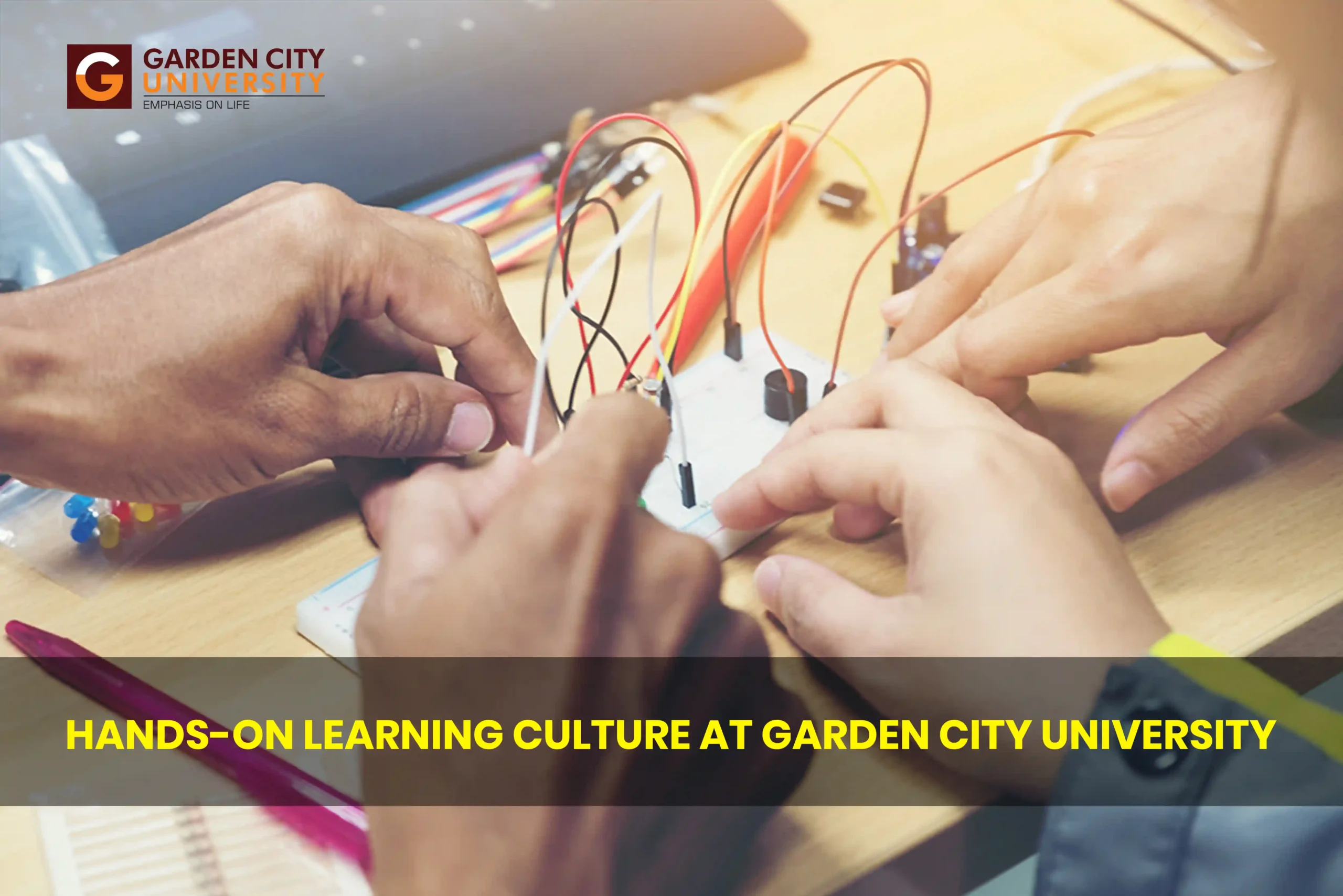
The traditional classroom is often too quiet, too predictable, and entirely too dependent on four walls. However, education here operates on a different frequency. We’ve largely moved away from the “lecture-and-forget” model because, let’s be honest, you don’t learn how to clone an orchid, manage a high-density forest, or process AI datasets by reading a PDF. You learn it through the grit of doing the work, hitting a wall, and trying again until it functions. This evolution from being a passive student to an active practitioner is what defines the hands-on learning culture at Garden City University. Instead of waiting for graduation to start a career, you are essentially entering a series of professional workshops. Whether you are in the Samsung SEED Lab or the Hoskote greenhouses, you aren’t just “practicing” for the real world—you are already in it. 1. Breaking the Classroom Wall with Hands-On Learning In most colleges, you spend three years reading about a process before you ever touch the equipment. At GCU, we flip that timeline. We don’t see “learning” as a passive act of sitting in a chair; we see it as an active apprenticeship. When your “classroom” shifts from a desk to a high-tech lab bench, a climate-controlled greenhouse, or a fast-paced newsroom, the stakes change. You aren’t just studying for an exam; you are performing a professional role. This is the core of the hands-on learning culture at Garden City University. 2. Turning Science into a Living Lab through Hands-On Learning If you’re a science student who hates staring at blackboards all day, you’ll find the Life Sciences setup here is designed to keep you on your feet. We focus on the Full Translational Spectrum, which is the process of taking a scientific discovery and turning it into a commercial or healthcare solution. Commercial Tissue Culture: Move beyond basic biology to master in-vitro propagation. You will learn the precision required to clone high-value crops like Orchids and Vanilla—a specific skill set that global export and pharmaceutical firms are actively hunting for. Controlled-Environment Agriculture: This is the intersection of engineering and biology. You will manage the sensors and climate controls needed for industrial-grade Microgreens production. The “Ayush” Field Lab: Our School of Sciences involves students in large-scale botanical research. You aren’t just reading about plants; you are following the quality standards used by pharmaceutical leaders like Himalaya Drug Company, making sure your research meets global export criteria. 3. Tech Specialization and Hands-On Learning in Innovation Innovation at GCU identifies where the biggest talent gaps are and builds labs to fill them. We focus on the high-value technical “moats” that make a resume stand out. Samsung SEED Lab: We host one of the few Samsung SEED Labs in India. This isn’t a place for dummy assignments; it’s where you work on live AI data for Samsung’s Bixby. Students can earn stipends around ₹25,000 for UGs and ₹35,000 for PGs while building a global resume. Semiconductor Packaging: Through our partnership with the Central Manufacturing Technology Institute (CMTI), engineering students get hands-on training in semiconductor packaging—a niche field usually only accessible at elite research institutes like IISc. The Census Research Lab: As one of only 14 authorized labs in Karnataka, we give students access to India’s complete 2011 Census dataset for predictive AI modeling and social policy research. 4. Operational Leadership: Club Mela and Campus Media The hands-on learning culture at Garden City University isn’t just about lab work. Career growth also requires “soft power.” Club Mela: Students manage 37 active clubs with a funding model based on actual events. This teaches you budgeting and coordinating different groups, which is exactly how a modern corporate office works. You can explore the scale of these initiatives in our Calendar of Events. Live Media Production: At “G News,” media students rotate through roles as anchors, editors, and producers, creating broadcast-ready content daily while mastering the AVGC-XR ecosystem. FAQ 1. How does hands-on learning help in job interviews? It changes the conversation. Instead of talking about what you “know,” you talk about what you have “done”—like managing a data set for Samsung or conducting a chemical analysis for a pharmaceutical project. You can see the outcomes of this in our Placement Report. 2. Are these projects officially recognized? Yes. Major research initiatives at GCU are supported by national bodies like the Ministry of Ayush, giving your work national-level credibility. 3. What is the benefit of the Entrepreneurship Lab? It provides the space and mentorship from CEOs to help you scale a project into a real business, ensuring you have the infrastructure to become a founder. Conclusion A degree tells an employer you can pass a test; a portfolio tells them you can do the job. The hands-on learning culture at Garden City University ensures you never feel like an amateur when you walk into your first professional interview. By combining core technical theory with high-frequency repetition, the university ensures you are industry-ready on Day Zero. If you’re ready to stop being a student and start being a practitioner, locking in your pathway at Garden City University is the most strategic career move you can make today.