
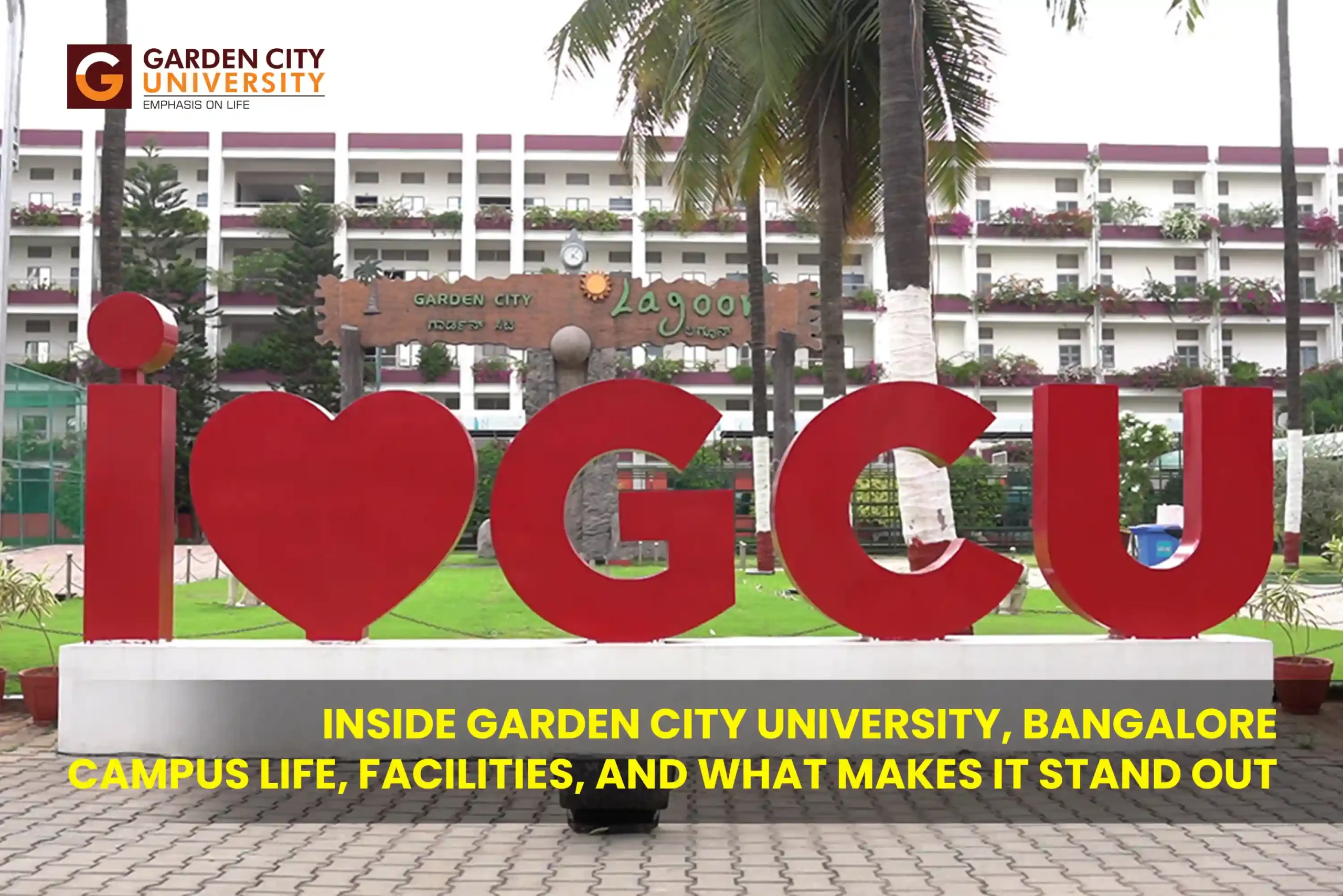
Choosing a university is not just about the degree at the end of it. Garden City University, proves that point clearly. It is about the three or four years spent getting there — the environment, the people, the opportunities that show up outside the classroom, and whether the institution actually does what it claims on its website.
Garden City University, Bangalore, is a private university that has been operating since 1992. It holds a NAAC A-grade accreditation, runs programmes across eight schools, and sits on a 52-acre campus. But what it looks like on paper is less interesting than what is actually happening inside it. Here is a closer look.
Table of Contents
ToggleA Campus That Functions as More Than a Study Space — Garden City University
The physical campus at Garden City University is designed to be used, not just occupied. The Hoskote campus includes a 10-acre Miyawaki forest. It was developed using the dense, multi-layered afforestation method pioneered by Japanese botanist Akira Miyawaki. The forest became self-sustaining within three years. It now serves as a working outdoor laboratory for Life Sciences and Environmental Science students. Students study biodiversity, ecology, and conservation in a real ecosystem — not a textbook.
The same campus grows Ashwagandha, Shatavari, orchids, vanilla, and microgreens. These are not decorative. They are active research and teaching environments. Students in Life Sciences programmes participate in national campaigns. They apply cultivation techniques in live settings and engage with the full value chain of a product from plant to market.
This is the kind of detail that gets overlooked in prospectus comparisons. The campus is not background — it is part of the curriculum.
Research That Goes Beyond the Classroom at Garden City University
Several departments at Garden City University run research projects with real-world implications and government backing.
The Department of Life Sciences, under Dr. Madhu Malleshappa, has led a Ministry of Ayush-funded Ashwagandha National Campaign. It distributed over two lakh saplings to farmers, households, and institutions across Karnataka. A buyback agreement with Himalaya Drug Company was established as part of the initiative. This gave students exposure to how scientific research connects to pharmaceutical supply chains.
Dr. L.A. Rama Chandra Prasad’s work spans multiple areas. He developed biodegradable plastic from corn starch. He published biomedical research on chemotherapy resistance in leukemia in a Springer Nature journal. He also leads a nutrition project exploring how rice combined with horse gram can address protein deficiency. Several students from these projects have gone on to PhD programmes. One is currently pursuing doctoral research in the United States.
Garden City University is also among only 14 institutions in Karnataka with an authorised Census Research Lab. It houses India’s complete 2011 Census dataset. The lab supports interdisciplinary research across social sciences, AI, machine learning, psychology, and public policy. Access is governed under strict confidentiality protocols.
These are not aspirational initiatives. They are active, documented, and producing outcomes.
Industry Partnerships That Actually Reach Students at Garden City University
One of the more distinctive programmes at Garden City University is the Samsung SEED Linguistics Lab. It supports development of Samsung’s AI assistant, Bixby, across multiple global languages. GCU is one of a small number of institutions in India selected to host this lab.
Students working in the lab receive structured datasets from Samsung. They translate AI-generated text into foreign languages and create audio recordings for contextual voice training. Undergraduate students earn monthly stipends of approximately ₹25,000. Postgraduate students earn around ₹35,000. Alumni of the lab have gone on to earn ₹70,000–₹80,000 per month in related AI linguistics roles.
The Engineering department holds an MoU with the Central Manufacturing Technology Institute (CMTI) for specialised semiconductor packaging training. This programme is currently offered at only two institutions in India. The other is IISc Bangalore.
The IEEE Student Branch at GCU has 108 active student members. They have access to international research networks, funded conference participation, and Scopus-indexed publications.
These are not one-off events. They are structural industry integrations that create consistent opportunities for students throughout their course.
Campus Life at Garden City University: What Students Actually Do
Garden City University runs 37 active student clubs. Participation is not optional — it is academically integrated, with structured credits attached. The Club Mela initiative introduces students to the full range of clubs each year. It runs as a half-day experiential platform. Students choose two clubs per semester. They are expected to attend approximately 80% of activities. Contributions are recognised through certificates that strengthen portfolios for placements and higher education applications.
The Gardenia festival is a three-day inter-university cultural and academic event. It brings students from institutions across Bangalore to GCU. A parallel competitive framework runs for internal students. Fresherism is a 15-day orientation programme for first-year students. It identifies the Top 100 students through a points-based system. Formal recognition is given by the Chancellor on stage.
Media students run a live campus newsroom — G News. Students rotate across roles as anchors, camera operators, editors, and writers on a daily production cycle. The platform has a Canada edition. Alumni of the programme are working in mainstream television. One former student currently leads anchoring operations at Karnataka TV with over 500 professional productions to her credit.
The Hotel Management department runs an annual Cake Mixing Ceremony. It uses a one-year maturation process — substantially longer than the conventional two-month standard. The recipe uses a 60:40 fruit-to-batter ratio. Ingredients include campus-grown produce from GCU’s own Hoskote estate.
Alumni of Garden City University Who Come Back — and Recruit
Garden City University’s alumni network includes professionals across industries who maintain active connections with the university. Mr. Ajit Rai is a 2004 alumnus and current Vice President at Stellar Innovations. He recently conducted a hiring drive at GCU. Mr. Abhishek is a 2002 Life Sciences graduate. He has worked across Microsoft, Uber, LinkedIn, and BrowserStack. He now leads an AI technology firm in Mumbai. These are not
FAQ
Yes. Garden City University holds a NAAC A-grade accreditation, which reflects its standing against national quality benchmarks across academics, research, infrastructure, and student outcomes.
GCU offers over 70 programmes across eight schools, covering disciplines including Computer Science, Management, Life Sciences, Engineering, Media Studies, Hotel Management, Linguistics, and more — at undergraduate, postgraduate, and doctoral levels.
GCU maintains active corporate relationships that bring companies to campus on a recurring basis rather than limiting recruitment to a single annual season. Alumni-led hiring drives, industry partnerships, and dedicated placement infrastructure contribute to consistent employment outcomes across departments.
Several things are genuinely distinctive: the Samsung SEED Linguistics Lab, the Census Research Lab, the Miyawaki forest campus, the CMTI semiconductor packaging tie-up, and an entrepreneurship lab with CEO and founder mentorship. These are not generic facilities — they are specific to GCU.
Yes. GCU has a significant number of students from Tamil Nadu, Kerala, Andhra Pradesh, and other states, as well as international exchange students. Being based in Bangalore means access to one of India’s most active employment ecosystems, which benefits students regardless of which programme they are enrolled in.
Conclusion
Most universities describe themselves in similar terms. What stands out at GCU is the specificity of what is actually happening — government-funded research producing pharmaceutical partnerships, a Samsung AI lab where students earn while they study, a live campus newsroom with international editions, a 10-acre forest used as a teaching environment, and alumni in senior roles who actively recruit from campus.
The degree is the starting point. What surrounds it at GCU is what makes the difference.
Atchaya S
Atchaya S is a content writer specializing in creating informative and engaging blog content on education, student life, and academic programs. With a keen eye for detail and a passion for storytelling, she focuses on delivering valuable insights that help students make informed decisions about their educational journey.