
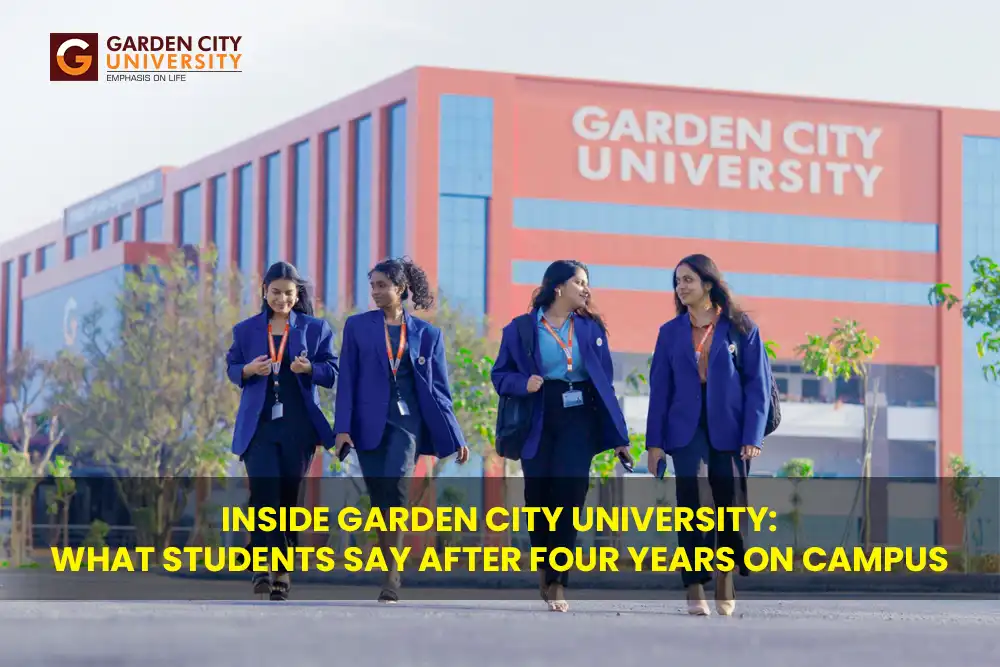
Inside Garden City University, Bangalore, things look different from what the outside suggests. Prospectus pages and ranking lists tell one version of the story. The students who have spent four years there tell another — and that version is worth paying attention to before you make a decision that shapes the next decade of your life. This blog brings together what students consistently say about their experience at GCU — the academics, the campus, the opportunities, and the moments that actually stayed with them.
Table of Contents
ToggleInside Garden City University: What Students Say About Academic Life
The first thing students notice is that the academic experience is more hands-on than they expected. Lectures exist — but they are not the whole picture. Live projects, industry assignments, laboratory work, and research opportunities are built into the programme structure across departments.
Life Sciences students talk about working in actual research environments — growing medicinal plants, participating in government-funded campaigns, and contributing to published research. Engineering students mention the Samsung SEED Linguistics Lab, where undergraduates earn monthly stipends while contributing to real AI development work. Meanwhile, media students run a live newsroom — G News — rotating across anchoring, editing, camera, and writing roles on a daily production cycle.
The consistent thread across departments is this: the university does not treat practical exposure as a bonus. Instead, it treats it as the point. Students who arrive expecting to sit through three years of theory and collect a degree leave having done actual work — and that difference shows up at placement time.
Inside Garden City University: The Campus Experience
Students who have spent time on campus consistently describe it as an environment that does something most campuses do not — it makes you want to be there.
The Hoskote campus includes a 10-acre Miyawaki forest that became self-sustaining within three years. It now functions as a working outdoor laboratory. The same campus grows Ashwagandha, orchids, vanilla, and microgreens — not as decoration but as active teaching and research environments. For Life Sciences and Environmental Science students, the campus itself is part of the curriculum.
Beyond the academic infrastructure, 37 active student clubs run on campus with participation integrated into the academic credit system. Students choose two clubs per semester and are expected to engage — not just attend. Additionally, the Gardenia festival brings students from institutions across Bangalore to the university every year. Fresherism, a 15-day orientation programme, identifies the top 100 first-year students through a structured points system with formal recognition from the Chancellor.
Students describe it as a campus where there is always something happening — and where the things happening are connected to real outcomes, not just entertainment.
Inside Garden City University: Opportunities Students Did Not Expect
Some of the most consistent feedback from students is about the opportunities they found that they did not know existed when they enrolled.
The Samsung SEED Linguistics Lab is one example. Undergraduate students working in the lab earn approximately ₹25,000 per month contributing to AI voice training for Samsung’s Bixby assistant. Postgraduate students, on the other hand, earn around ₹35,000. Alumni of the lab have gone on to earn ₹70,000–₹80,000 per month in AI linguistics roles. Students who joined for a Computer Science degree found themselves contributing to a global AI product before they graduated.
The Census Research Lab — one of only 14 authorised in Karnataka — gives students access to India’s complete 2011 Census dataset. This enables interdisciplinary research across social sciences, AI, machine learning, and public policy. Furthermore, engineering students have access to semiconductor packaging training through an MoU with the Central Manufacturing Technology Institute — a programme available at only two institutions in India, the other being IISc Bangalore.
These are not opportunities that appear in every college brochure. They are the kind of thing students discover after they arrive — and consistently mention when they reflect on what made their time there different.
Inside Garden City University: What Alumni Say Looking Back
The graduates who have entered the workforce tell a consistent story: they were more prepared than they expected to be.
Mr. Abhishek, a 2002 Life Sciences graduate, has worked across Microsoft, Uber, LinkedIn, and BrowserStack and now leads an AI technology firm in Mumbai. Similarly, Mr. Ajit Rai, a 2004 alumnus, is currently Vice President at Stellar Innovations and recently returned to conduct a hiring drive. These are not exceptional outliers — they are part of a pattern of alumni who maintained their connection to the university and actively contribute to the next generation of students through mentorship and recruitment.
Media alumni are anchoring on Karnataka TV. Life Sciences alumni are pursuing PhDs in the United States. Engineering alumni are working in AI linguistics roles earning packages that most undergraduate programmes would not predict at graduation.
What alumni consistently reflect on is not just what they learned — it is the environment that shaped how they approached work. The habits built during those four years — curiosity, practical engagement, willingness to take on real responsibility — are ultimately the things that stayed with them.
FAQ
Garden City University holds a NAAC A-grade accreditation, runs programmes across eight schools on a 52-acre campus, and has active industry partnerships including Samsung, CMTI, and IEEE. Student outcomes — including placement records and alumni career trajectories — reflect a programme that consistently delivers on its stated priorities.
Garden City University runs 37 active student clubs with academic credit integration, hosts the Gardenia inter-university festival annually, and provides a campus environment that includes a 10-acre Miyawaki forest and active research facilities. Students describe campus life as engaged, varied, and connected to real outcomes.
Garden City University maintains long-term relationships with recruiting companies rather than relying on a single annual placement season. Alumni from across departments have gone on to work at companies including Microsoft, Uber, BrowserStack, Karnataka TV, and Samsung-affiliated organisations. Placement support is built around consistent industry engagement throughout the programme.
Yes. Undergraduate students at Garden City University have access to research environments across multiple departments — including the Samsung SEED Linguistics Lab, the Census Research Lab, and faculty-led research projects in Life Sciences and Engineering. Several undergraduate students have contributed to published research and gone on to pursue PhDs.
Garden City University is located in Bangalore, Karnataka. The main campus is in Rayanapura, Kasaba Hobli, with the Hoskote campus housing the Miyawaki forest, research farms, and extended facilities.
Conclusion
Four years at any university shapes more than a resume. It shapes how you think, what you expect from yourself, and what kind of professional you become. The students who have spent four years at Garden City University consistently describe an experience that went further than they anticipated — more practical, more connected to real industry, and more invested in their individual development than a standard undergraduate programme.
If you are evaluating where to spend the next three or four years, the experience of the students who came before you is worth more than any ranking. Garden City University, Bangalore has built a campus where that experience consistently delivers — and the alumni who return to recruit are the clearest evidence of that.
Atchaya S
Atchaya S is a content writer specializing in creating informative and engaging blog content on education, student life, and academic programs. With a keen eye for detail and a passion for storytelling, she focuses on delivering valuable insights that help students make informed decisions about their educational journey.