
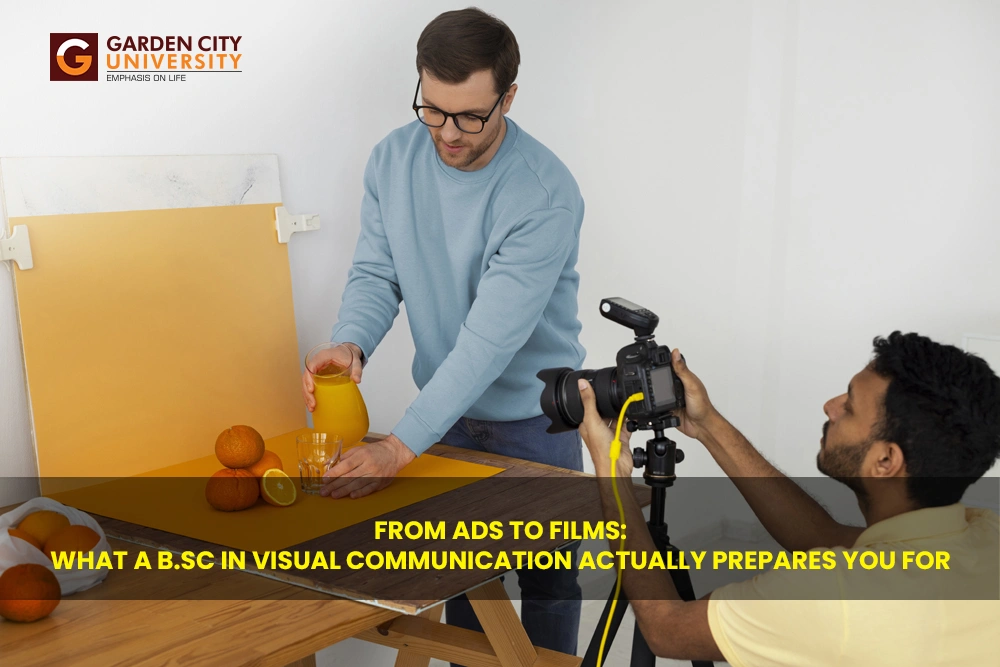
BSc in Visual Communication opens doors that most students do not see coming when they first enrol. The degree has a reputation for being a creative choice — something you pursue if you love photography or design. But the professionals working in India’s fastest-growing media, advertising, and film industries did not get there by accident. In fact, many of them started exactly where you are now — choosing a degree that gave them a language the world increasingly speaks fluently: visual storytelling. This blog breaks down what the degree genuinely prepares you for, and why the careers on the other side of it are more varied and more in demand than most people realise.
Table of Contents
ToggleWhat BSc in Visual Communication Actually Teaches You
The BSc in Visual Communication is built around one core idea: communication through visuals is a skill that can be learned, refined, and applied professionally across multiple industries. The degree covers photography, videography, graphic design, typography, advertising design, film production, editing, and media theory — not as isolated subjects but as an integrated toolkit.
Students learn how to tell a story through an image, how to build a brand identity through design, and how to write, shoot, and edit a film. Beyond technique, they also learn how audiences read visual content — and how to design that content to create specific responses.
This is not a narrow creative arts degree. Rather, it is a communication degree that happens to use visual media as its primary language. That distinction matters when you are explaining the degree to employers — and when you are figuring out which industry you want to work in after graduation.
The Advertising and Brand Industry — Where BSc in Visual Communication Graduates Start Strong
Advertising is where most BSc in Visual Communication graduates find their first professional footing — and for good reason. The degree directly prepares students for the roles that advertising agencies, brand studios, and in-house marketing teams are actively hiring for.
Art director, visual designer, brand identity specialist, creative executive, and social media content creator are all roles that draw directly from what this degree builds. Moreover, companies across every sector — consumer goods, technology, retail, finance, healthcare — run marketing operations that need people who can translate ideas into visuals that work.
The shift to digital advertising has made this more relevant, not less. Every brand now produces content daily — for Instagram, YouTube, OTT platforms, and digital out-of-home formats. As a result, the volume of visual content being created has never been higher. The professionals who understand both the creative and the strategic side of that content are exactly what the industry is looking for.
Film, OTT, and Media — The Growing Opportunity for BSc in Visual Communication Graduates
India’s entertainment industry is expanding at a pace that would have been hard to predict a decade ago. OTT platforms — Netflix, Amazon Prime, Disney+ Hotstar, SonyLIV, and a growing list of regional players — are commissioning original content at scale. Consequently, that content needs directors, cinematographers, editors, production designers, sound designers, and creative producers. Many of those roles are filled by graduates with exactly the kind of training a BSc in Visual Communication provides.
The degree covers film production as a core component — not a peripheral module. Students learn pre-production planning, cinematography, direction, post-production editing, and sound design. They also work on real productions during the course. By graduation, they have a portfolio that demonstrates what they can actually do — which is what the film and media industry cares about far more than the name of the degree.
Documentary filmmaking, corporate video production, music video direction, and digital content creation for brands are all adjacent areas where graduates are finding strong opportunities. Furthermore, the industry is large, it is growing, and it consistently needs new creative talent.
Digital Media, UX, and Journalism — The Other Careers a BSc in Visual Communication Opens
The careers available to BSc in Visual Communication graduates extend well beyond advertising and film. Digital journalism, photojournalism, UX and UI design, motion graphics, and animation are all fields where this degree provides a relevant foundation.
UX and UI design in particular has become a significant career path for visual communication graduates. As product companies and startups invest in better user experiences, demand for designers who understand visual hierarchy, user psychology, and communication design has grown steadily. Additionally, a BSc in Visual Communication graduate who builds on the degree with UX-specific tools and portfolio work is well-positioned for this transition.
Photojournalism and documentary photography remain viable careers for graduates who combine technical skill with storytelling instinct. Digital news platforms, NGOs, international organisations, and independent media outlets consistently need visual journalists who can work across formats.
What to Look For in a BSc in Visual Communication Programme
Not every BSc in Visual Communication programme delivers the same outcome. The quality of studio infrastructure, the relevance of the curriculum to current industry tools, the experience of the faculty, and the strength of industry connections all determine where graduates end up.
First, look for programmes that give students access to professional-grade equipment — cameras, editing suites, design software, and production studios. The degree is fundamentally practical, so a programme that delivers it primarily through lectures and theory is not preparing students for an industry that evaluates them on their work.
Industry exposure matters too — guest lectures from working professionals, live briefs from real clients, internship facilitation, and a placement record that shows actual outcomes. Finally, ask about where alumni are working. That tells you more than any prospectus will.
FAQ
It’s massive and expanding fast. India’s media and entertainment sector is booming, meaning constant demand for visual talent. Graduates go straight into film production, OTT networks, advertising agencies, UX design, digital journalism, and social media management.
Mass Comm is broader, covering print, news broadcasting, and PR. Visual Communication zooms in specifically on design and sight—focusing heavily on filmmaking, photography, graphic design, and modern visual storytelling.
Absolutely. Filmmaking is a core part of the syllabus. You’ll learn direction, cinematography, editing, and production design, which directly prepares you for cinema, OTT content, documentaries, and commercial video production.
It’s one of the best choices out there. Instead of just studying abstract art, it teaches you how to turn your raw creativity into highly bankable, practical skills that companies and studios are actively paying for.
You’ll walk away with a solid portfolio in photography, videography, graphic design, film editing, and brand communication. The exact mix depends on the projects and specialties you choose to focus on during the course.
Conclusion
The BSc in Visual Communication is not a narrow degree for students who want to draw or take photographs. It is a professional qualification that prepares graduates for careers across advertising, film, digital media, journalism, and design — industries that are growing, hiring, and consistently looking for people who can communicate visually with skill and intention.
The outcome depends significantly on where you study and the quality of practical training the programme delivers. Garden City University, Bangalore offers a BSc in Visual Communication built around industry-relevant curriculum, professional studio infrastructure, and placement support that connects graduates with the media and creative industries they are trained for.
Atchaya S
Atchaya S is a content writer specializing in creating informative and engaging blog content on education, student life, and academic programs. With a keen eye for detail and a passion for storytelling, she focuses on delivering valuable insights that help students make informed decisions about their educational journey.